Kaliningrad: A History My Tourists Often Ask About
As a guide, I often get questions about Kaliningrad – a small region on the Baltic Sea, located between Lithuania and Poland. Many tourists find it unusual because it is part of Russia but not connected to it by land. To understand why, we need to look into history.
Let’s start with Old Prussia. When people hear “Prussia,” they usually think of Germany and Germans. But in the Middle Ages, this land was neither German nor Russian. It was home to the Old Prussians, a Baltic people related to Lithuanians and Latvians. They were pagans and spoke a Baltic language that no longer exists today.
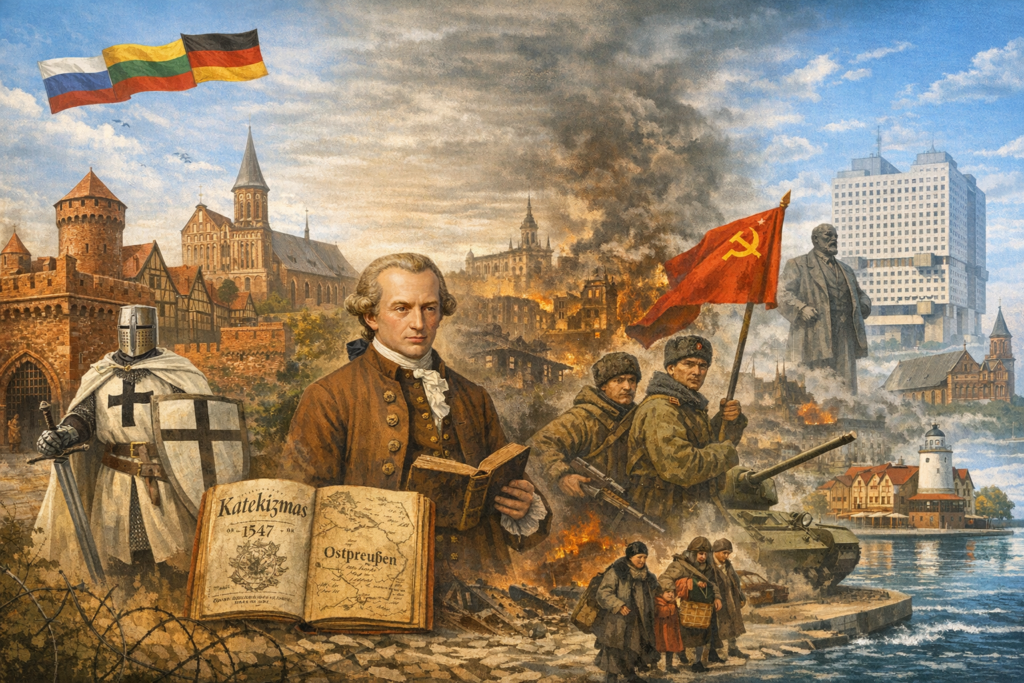
In the 13th century, the Teutonic Order arrived. They conquered the land and gradually destroyed or assimilated the local tribes. Castles were built, cities were founded, and German settlers moved in. One of these cities was Königsberg, founded in 1255.
The name Königsberg means “King’s Mountain,” named after Ottokar II of Bohemia, a powerful ruler who supported the Teutonic Knights. Over time, the city became an important cultural and academic center. The University of Königsberg was founded in 1544, and later became famous because the philosopher Immanuel Kant studied and worked there his entire life.
In the 16th century, the Teutonic Order was secularized, and the land became the Duchy of Prussia – the first Protestant state in Europe. At first, it was a vassal of Poland. Later, Prussia grew stronger. In 1701, it became the Kingdom of Prussia, which eventually led the unification of Germany under Otto von Bismarck in 1871.
This region became known as East Prussia, the easternmost part of the German world. But it was not only German. Lithuanian-speaking people, known as Lietuvininkai, lived here as well. They were Protestants and preserved their language and traditions. The first Lithuanian book, the Catechism, was printed in Königsberg in 1547. In the 19th century, when Lithuania was under the Russian Empire and Lithuanian printing in Latin letters was banned, this region became an important center for Lithuanian culture. Books were printed here and secretly transported into Lithuania.
For centuries, different groups lived side by side. German cities, Lithuanian villages, and shared economic life created a mixed culture. East Prussia was closely connected to German culture, while the countryside preserved older Baltic traditions. Importantly, this region had never been part of Russia, and there were no Russians living here.
Everything changed in the 20th century. After World War I, East Prussia was separated from the rest of Germany but remained German. The real turning point came during World War II, when the Soviet army invaded in 1944–1945. The fighting was brutal, and cities, including Königsberg, were heavily destroyed. Many civilians tried to flee west, and thousands died from cold, hunger, bombings, and ship sinkings in the Baltic Sea.
After the war, East Prussia was divided. The southern part went to Poland, and the northern part, including Königsberg, became part of the Soviet Union. Almost all remaining local inhabitants were removed, including the Lietuvininkai. Some fled, some were deported, and some were assimilated. A culture that had existed for centuries disappeared in just a few years.
In 1946, Königsberg was renamed Kaliningrad, after Mikhail Kalinin, a Bolshevik revolutionary and formal head of state of the Soviet Union, even though he had no direct connection to the region.
Between 1945 and 1948, new people began to arrive – mostly from Russia, but also from Ukraine and Belarus. Some came voluntarily, seeking work or a new life, but many were resettled by the Soviet state. The remaining German population had almost no rights, often used as forced labor, and by 1948, most had been deported to Germany.
Kaliningrad became a closed military region. Foreigners were not allowed, and even Soviet citizens needed special permits. The area was heavily militarized and cut off from its past for decades.
After the collapse of the Soviet Union in 1991, Kaliningrad remained part of Russia, but now separated from it by independent Lithuania and Poland. This created a unique situation: a Russian region surrounded by European Union and NATO countries.
In recent years, interest in the past has grown. Some historical buildings are being restored, and Kant is remembered again. But the break in population is complete. Today’s inhabitants have no direct connection to those who lived here before 1945.
Excursions in Vilnius, cycle tours, tasting tours, museum visits and day trips to Trakai, Kaunas, or other places can be arranged with one of our guides toseevilnius@gmail.com
For more information about tours in Vilnius and Lithuania, visit Vilniusplus.com